
As the fires continue burning

My last newsletter ended with recommendations for how you could support people in Los Angeles who’d been hit by the January wildfires. Today, a very different fire is burning here. I’ll close this newsletter with resources for how you can support our immigrant communities hardest hit by ICE raids.
Five-day book club on the Lake Michigan shore
When the news is overwhelming, I’ve found that long-form reading allows me to reflect on current events in a way that’s less stressful and helps me think more constructively about both the present and the future. In that spirit, I’m bringing the popular Democracy Book Club back to Björklunden in Door County on the week of September 7-12. I’d love for you to join me for this five-day conversation about five books that I’ve found insightful and inspiring:
I decided to start with A Paradise Built in Hell by Rebecca Solnit because it takes us straight to the days and weeks after natural disasters, describing in detail how communities have gathered together to support each other when systems they rely on physically collapsed. Using disaster as a lens to look at what’s happening today can help us think about the time that will come when this current crisis is behind us. How will we want to rebuild our communities? What part of that rebuilding can we begin today? I’ve followed that book with Pacific Edge by Kim Stanley Robinson, a novel set in a utopian future where people run errands on bicycles and asphalt is dug up to reclaim land for sports fields, but city council meetings are the same slog they are today. The hyper-local focus will help us talk about how we can engage with our local communities to make positive change, even in the midst of a national crisis. The story also teaches us that utopia is a process, not an endpoint.
Next we’ll dig into our troubled past with Black Reconstruction in America by W.E.B. Dubois. Post-Civil War reconstruction was a period of great promise, but powerful actors who did not want former slaves to have political power crushed their rising freedom in ways that continue to distort democracy in America today. DuBois lays out this history with deep research and resonant prose. The book is too long and detailed to explore in its entirety, so we’ll discuss chapters 3, 7, 9 and 16, focusing on what we can learn from history to help us build a better democracy for the future.
“Back of the writhing, yelling, cruel-eyed demons who break, destroy, maim and lynch and burn at the stake, is a knot, large or small, of normal human beings, and these human beings at heart are desperately afraid of something.”
—W.E.B. Dubois, Black Reconstruction in America
To understand The Pyramid, it helps to know that its Albanian author, Ismail Kadare, wrote it as one of the Soviet Union’s most repressive dictatorships was beginning to collapse. His novel tells the construction story of the Great Pyramid of Giza in a political allegory about big, beautiful, useless vanity projects that is as hilarious as it is incisive. We’ll close out the week by discussing On Freedom by Timothy Snyder, where he shows us the difference between “freedom from” and a more empowering concept of “freedom to” do the things that matter to us most. Our conversation about this book will help us to think about the future of our freedoms and what part we want to play in them.
You can register for the seminar here. If you’d like to learn more, reply to this email and I’ll happily respond.
Trees and democracy
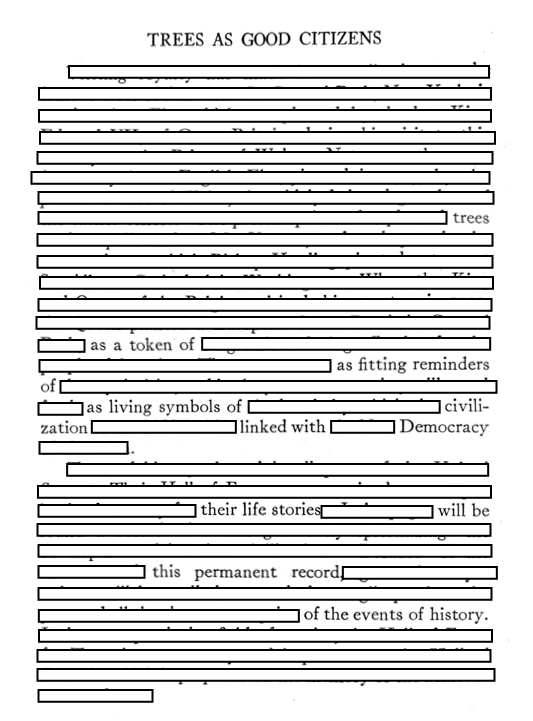
I’m working on a new zine right now made up entirely of whiteout poetry, using text from books that are in the public domain. The original inspiration comes from Trees as Good Citizens by Charles Lathrop Pack, which I found at a tour of Occidental College’s Moore Lab of Zoology. Here’s a sneak peek at the title poem:
How you can help hard-hit immigrant communities
Immigrant communities in Southern California and across the US are under attack, with masked agents kidnapping people from their workplaces, houses of worship, and off the streets. People are being detained sometimes in inhumane conditions and often denied their rights. An activist group I’m part of — Artists 4 Democracy — sent out this Urgent report from Los Angeles on June 11 to help folks understand what’s really going on here. If you’d like to help the people hardest hit by ICE raids, here are three excellent national organizations you can support:
Coalition for Human Immigrant Rights (CHIRLA)
If you’re in the LA area, several YMCAs are collecting donations of groceries for care packages that they’re delivering to people unable to leave their homes due to the raids.
Wherever you are and whatever platform you might have — even if that just means talking to friends and family — now is the time to speak out for those who are under attack, while you still can.